
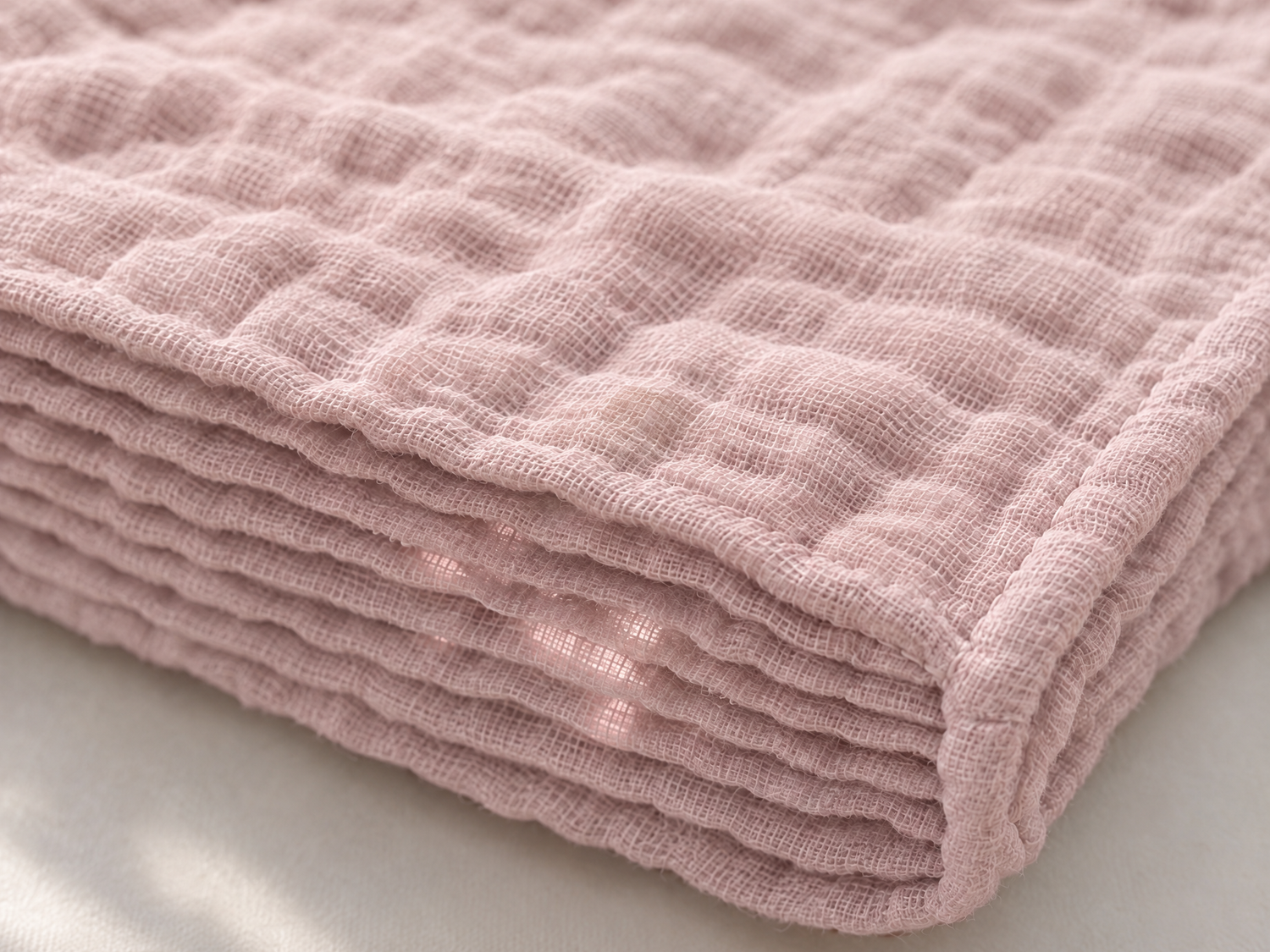
Muslin, waffle, linen, bamboo and fleece blankets differ in two ways: the fiber, and how the fabric is built. Muslin is layered cotton gauze, waffle is a textured grid weave, linen is woven from flax, most "bamboo" is rayon made from bamboo, and fleece is usually brushed polyester. Each suits a different sleeper, season and care routine.
The five fabrics at a glance
| Fabric | Fiber and construction | Feel | Warmth and weight | Care notes | Often used for |
|---|---|---|---|---|---|
| Muslin (gauze) | Cotton; thin, open plain weave, stitched in 2 to 8+ layers | Soft, crinkled, relaxed | Light to medium, depending on layer count | Machine washable; open weave can catch on rings and claws | Light bed layer, couch throw |
| Waffle | Usually cotton, sometimes microfiber or linen; a grid of raised squares and hollows | Textured, structured | Light to medium, depending on fabric weight | Follows the fiber; cotton waffle washes like other cotton | Summer blanket, layering, towels and robes |
| Linen | Flax; woven | Crisp at first, softens with washing | Varies with the weave and fabric weight | Strong; wrinkles easily | Warm-weather bedding |
| Bamboo | Usually rayon (viscose) made from bamboo; woven or knitted | Usually smooth, with drape | Varies with the weave or knit | Follow the label closely | Sheets, light blankets |
| Fleece | Polyester; knitted and brushed (napped) | Fuzzy, plush | Built for warmth; the napped surface traps air | Dries fast; lower grades can pill | Cold nights, the couch, camping |
Fiber and construction are two separate questions
When people compare blankets, they usually compare fibers: cotton versus linen versus polyester. But the way a fabric is built matters just as much, especially for how it feels on a warm night.
- Fiber is the raw material: cotton, flax, rayon, polyester.
- Construction is what's done with it: a tight or open weave, a textured weave, a knit, a brushed surface, a single layer or several.
The same cotton can become a dense canvas or an airy gauze. That's why "is cotton breathable?" doesn't have one answer, and why we describe each fabric below by how it's put together rather than ranking them on a single scale.
The five fabrics, one by one
Muslin: layered cotton gauze
Muslin is a plain-woven cotton fabric, and blankets use a thin, loosely woven version of it, usually called gauze. A single layer is almost see-through, so blankets stitch several layers together and wash them so they crinkle. Warmth depends mostly on layer count: two to four layers is a light throw, while six to eight has more body (see 4 vs 6 vs 8 layers). There's no fill, so air can move through the weave rather than meeting one dense mass. The trade-off: the open weave can catch on rough nails, rings and pet claws. Our guide to what a muslin blanket is covers the fabric in more depth.
Suits: people who want a soft, light layer they can wash often and add or remove through the night.
Waffle: a textured weave
Waffle (also called honeycomb) is a weave, not a fiber. Long floating threads form a grid of small raised squares and hollows, and the fabric is usually made of cotton or microfiber, sometimes linen. That three-dimensional texture is why waffle is popular for towels and robes, and the same reference notes the weave lets air flow through so the fabric dries quickly. As a blanket, it's usually a single layer whose warmth depends on how heavy the fabric is.
Suits: people who like visible texture and a tailored look, and want a single-layer blanket for warmer months.
Linen: woven from flax
Linen is made from the fibers of the flax plant. It's very strong and absorbent, dries faster than cotton, and tends to feel cool to the touch, which is linked to its higher thermal conductivity. It also has low elasticity, so it wrinkles easily, and it gets softer the more it's washed. A new linen blanket can feel crisp; an older one feels relaxed and soft.
Suits: people who like a crisp, cool-feeling hand that softens with age, and don't mind a rumpled look.
Bamboo: usually rayon made from bamboo
Here the label matters. According to the US Federal Trade Commission, most textiles sold as "bamboo" are really rayon, a manufactured fiber for which bamboo is the plant source, and no trace of the original plant remains in the finished fiber. Unless a fabric is made directly from bamboo fiber (sometimes called mechanically processed bamboo), the FTC says it should be labeled and advertised with the generic fiber name, such as "rayon made from bamboo." Bedding sold this way is usually marketed for a smooth, silky feel, and how warm or airy it is depends on whether it's woven or knitted, and how tightly.
Suits: people who like a smooth, slippery hand. Read the fiber content rather than the product name.
Fleece: brushed polyester
Polar fleece is a soft, napped, insulating fabric made from polyester. Brushing raises the surface, and higher-loft fleece traps tiny air pockets that hold body heat. It repels water, holds very little of it when wet, and dries quickly. The downsides: lower-quality fleece is prone to pilling, and washing synthetic textiles like fleece releases microfibers.
Suits: people who run cold, winter evenings on the couch, and anyone who wants an easy-care, fast-drying blanket.
How to choose
- You run hot but like to feel covered: look for a thin, open construction you can layer, such as a muslin, a light waffle or a linen blanket.
- You run cold, or want the warmest option for the couch: fleece is built for warmth.
- You like texture: waffle. Crisp and rumpled: linen. Smooth and silky: bamboo rayon. Soft and crinkled: muslin.
- You want low-fuss care: all five can be easy, but read the label. Muslin needs gentle handling around snags, linen wrinkles, and fleece can pill.
- You share a bed and disagree on warmth: pick a blanket each rather than one fabric for both. Two different fabrics on one bed is perfectly normal.
If you're weighing up blankets marketed as "cooling" as well, our explainer on cooling blankets vs breathable cotton covers how those differ from the fabrics above.
Where we stand
A disclosure: we make one blanket, so read this with that in mind. Ours is a 6-layer cotton muslin blanket: six layers of 100% cotton gauze, crinkled, with bound edges and no fill. It's a personal size, about 45″ × 73″ (115 × 185 cm) relaxed, made for one adult. We chose muslin for its layered construction, not because the other fabrics are bad. Plenty of people will be happier with linen, waffle or fleece.
If muslin is your pick, every order is Buy 1, Get 1 Free, so two blankets arrive in any mix of Sky Blue, Sand and Blush. And our 30-Night Comfort Guarantee means you can email us within 30 nights of delivery for a full refund if it isn't right, with no need to send it back.
FAQ
What's the difference between a muslin and a waffle blanket?
Muslin is several thin layers of cotton gauze stitched together and crinkled. Waffle is usually a single layer of fabric woven into a grid of raised squares and hollows. Both are often cotton; they differ in construction, feel and look.
Is muslin the same as gauze?
For blankets, the words are used almost interchangeably. Muslin is a plain-woven cotton fabric, and the thin, open version used in blankets is usually called gauze or cotton gauze.
Is a bamboo blanket really made of bamboo?
Usually not directly. The FTC says most bamboo textiles are rayon made using bamboo as the plant source, and should be labeled as rayon or "rayon made from bamboo" unless they're made directly from bamboo fiber.
Does linen feel cool to the touch?
It tends to, because linen has higher thermal conductivity than many fabrics. That's a description of how it feels on contact, not a promise about your body temperature.
Which of these blankets is warmest?
Fleece is designed to insulate, so it's usually the warmest of the five. A muslin blanket's warmth depends on its layer count, and waffle, linen and bamboo depend on the weight and tightness of the fabric.