
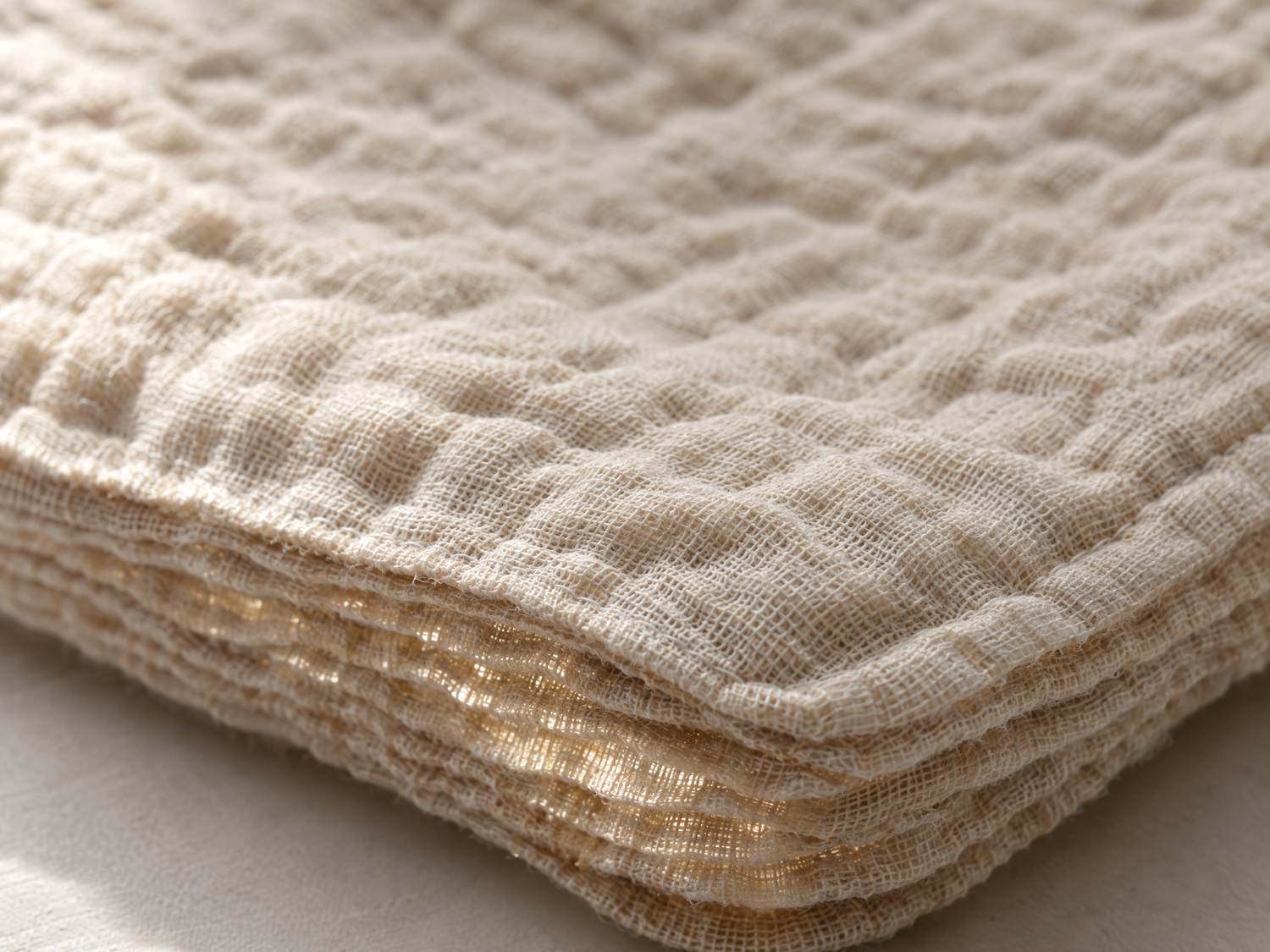
A muslin blanket is made from several layers of thin, loosely woven cotton gauze, stitched together into one soft, crinkled piece. Adult sizes usually have four to eight layers. The result is light and airy but still feels like a real blanket: something to sleep under on its own when it's warm, or to layer when it isn't.
Muslin today vs the muslin of history
What the word means now
In bedding, "muslin" now means a lightweight cotton in a simple plain weave: one thread over, one thread under. Most muslin blankets use the most open, airy version of that cloth, cotton gauze. Hold a single layer of it up to a window and you'll see light through it. Stack several layers, stitch them together, and you have a blanket.
The word has other meanings too. In American sewing, "muslin" also means a plain, inexpensive cotton used to make test versions of garments, and the test garment itself is sometimes called "a muslin" (Wikipedia's muslin entry covers both uses). That cloth is firmer and plainer than anything you'd want to sleep under. If you've touched "muslin" at a fabric store and wondered why anyone would make a blanket from it, that's why.
"Woven air": the historical cloth
Historical muslin was a different thing altogether. The name is usually traced to the city of Mosul, in present-day Iraq, though some historians point instead to Masulipatnam, a port on India's Coromandel Coast. The most famous muslin was woven in Bengal, around Dhaka, and it was so fine it was known as "woven air." According to Smithsonian Magazine, Dhaka muslin had historical thread counts of 800 to 1,200, against roughly 40 to 80 for most muslin made today. It was worn by European elites in the 1700s and early 1800s, and the trade collapsed after the British East India Company took control of it. The techniques were lost along with it.
So, to be clear about what you're buying: a modern muslin blanket shares a name and a basic weave with that cloth. It doesn't share its rarity. That's worth remembering when a product page leans hard on the history.
Muslin vs gauze vs double gauze
These words overlap in shops, which is why so many people search for the difference. Here's how they're generally used:
| Term | What it is | How it feels | Where you'll see it |
|---|---|---|---|
| Muslin | A broad name for plain-weave cotton, from sheer to fairly sturdy | Anything from airy to stiff, depending on the weave | Blankets, bedding, fabric stores, kitchen straining cloths |
| Gauze | A thin, loosely woven, open fabric, usually cotton | Very light and see-through | Light clothing, curtains, blankets |
| Double gauze | Two layers of gauze joined at small, regular points so they act as one cloth | Soft, crinkly, less see-through than single gauze | Shirts, pajamas, light blankets |
| Muslin blanket | Several layers of cotton gauze, often 4 to 8, stitched into one piece | Soft and crinkled, light with some body | Beds and sofas |
The short version: gauze is the fabric (a thin, open weave, usually of cotton), double gauze is two layers of it, and a muslin blanket is several layers of it. When a blanket is sold as "muslin" or as "gauze," it's usually the same kind of product.
Crinkle and layers: how a muslin blanket is built
Why it's crinkled
Loosely woven cotton draws in when it's washed and dried. In a muslin blanket, the layers are held together by lines of stitching, so instead of shrinking evenly, the fabric bunches up between the stitches. That bunching is the crinkle.
It's not a flaw to be ironed out. The crinkle keeps the layers from lying dead flat against each other, gives the blanket its relaxed look and hides creases. It also explains one of the most confusing things about these blankets: they have two sizes. Pulled flat at the corners, a crinkled blanket measures much bigger than it does lying on a bed. Our muslin blanket size guide explains how to read both numbers.
How many layers is normal?
Layer count is the main thing that separates one muslin blanket from another. As a rough guide:
- Two layers: very light, close to a sheet.
- Four layers: light, with a bit of body.
- Six layers: the middle ground, with proper blanket feel that's still airy.
- Eight or more: noticeably warmer and heavier, more of a cold-weather blanket.
More layers hold more air, so they add warmth, and they add weight too. We go through the trade-offs in 4 vs 6 vs 8 layers: how many should a muslin blanket have?
How adults use muslin blankets
- On the bed, on its own. As the only cover on warm nights, over a fitted sheet or a top sheet.
- On the bed, as a layer. Under a comforter, duvet or doona in cooler months, so you can push the heavy layer off and keep something light on.
- On the couch. As a throw for reading or a movie. Muslin drapes and folds easily, so it sits well over the arm of a sofa.
- A blanket each. Couples who run at different temperatures use one each instead of fighting over a shared comforter, a habit sometimes called the Scandinavian sleep method.
If you're asking because you run warm at night, we answer that question on its own in are muslin blankets good for hot sleepers?
Why muslin blankets became popular with adults
For a long time, most people only came across muslin in small sizes. Adult blankets caught on for practical reasons:
- The in-between problem. Plenty of people find a comforter too heavy and a sheet too little. A muslin blanket sits in between.
- Layering is flexible. One light blanket plus one heavier cover gives you more settings than a single thick one.
- The look. A crinkled blanket looks intentional even when it was thrown on in a hurry.
- Simple care. Most cotton gauze blankets go straight in the washing machine.
- Personal sizes. A blanket sized for one suits couples who want their own.
Type "muslin blanket" into a search bar today and "for adults" is usually one of the first suggestions.
What to look for when buying a muslin blanket
- A stated layer count. Without it, you can't compare one blanket with another.
- The size, listed both ways. Look for the relaxed size (how it lies after washing) and the stretched size (pulled flat). If only one number is given, ask which it is, and whether it was measured before or after washing.
- 100% cotton on the fiber content. "Muslin" and "gauze" describe the fabric, not the fiber, so check the label for the fiber itself.
- Care instructions that make sense. Wash temperature, whether it can go in the dryer, and an honest note that a little lint in the first washes is normal.
- Finished edges. Bound edges keep the layers neat where they meet.
- A snag warning. Open-weave gauze can catch on rough nails, rings and pet claws. A maker who tells you so is being straight with you.
For reference, here's how ours answers that list: our 6-layer cotton muslin blanket is six layers of 100% cotton gauze with bound edges and no fill, sized for one adult at about 45 × 73 in (115 × 185 cm) relaxed and 63 × 83 in (160 × 210 cm) stretched. The relaxed size is measured after a wash and dry, so the first wash is already allowed for. It comes in Sky Blue, Sand and Blush.
Every order is Buy 1, Get 1 Free, so two blankets arrive and you can mix the colors. And if it isn't right for you, our 30-Night Comfort Guarantee means you email us within 30 nights of delivery for a full refund, with no need to send it back.
FAQ
What are muslin blankets made of?
Usually cotton gauze: thin, loosely woven cotton in a plain weave, layered and stitched into one blanket. Check the label for the fiber content. Ours is 100% cotton.
Why are they called muslin blankets?
Because they're made from muslin, a plain-weave cotton. The word itself is usually traced to the city of Mosul, though historians don't all agree on that.
Is muslin the same as gauze?
Close enough, in blankets. Gauze is the thin, open-weave cotton that "muslin" refers to when it's used for bedding, and shops use the two words for the same kind of blanket.
Do muslin blankets get softer?
Cotton gauze generally relaxes and softens with washing. Ours gets softer with every wash, and the crinkle is part of the design.
Are muslin blankets warm?
It depends on the layer count. Two or four layers is light. Six or more feels like a real blanket. In winter, a common setup is a muslin blanket under a comforter, duvet or doona.