
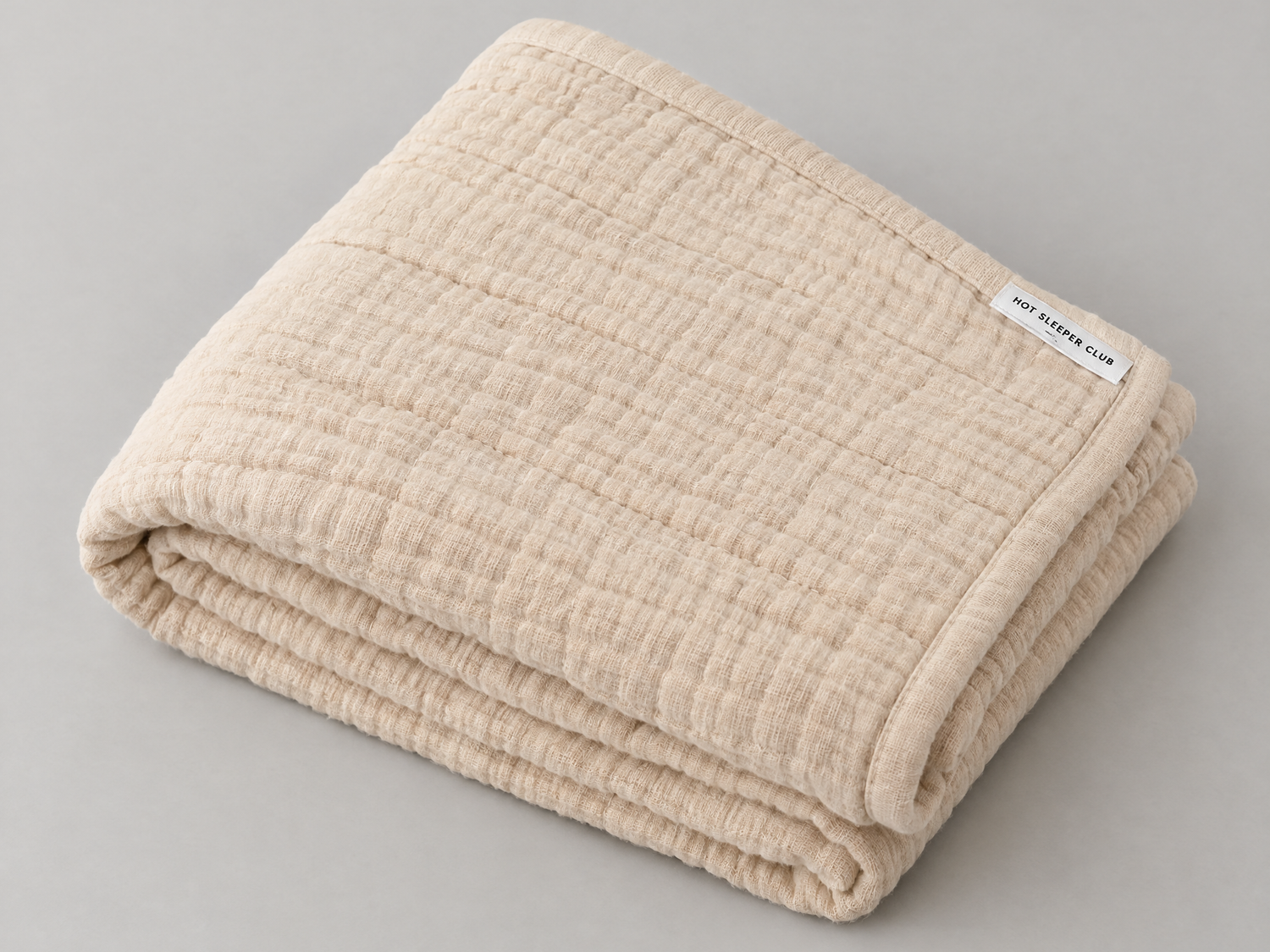
Check the care label, then wash your muslin blanket on a gentle cycle in warm water (max 40°C / 104°F) with no bleach. Tumble dry on low or line dry. Wash it on its own the first time. Cotton muslin can draw in a little during early washes as the crinkle settles. That's normal, not damage.
Below: the full routine, what shrinkage really is, drying, and the odd snag. Where we say "ours", we mean our own blanket's care rules; for any other muslin blanket, its label wins.
Muslin blanket care at a glance
| Step | What to do | Why |
|---|---|---|
| Wash | Warm, max 40°C / 104°F, gentle cycle | Hot water can shrink and fade cotton; gentle agitation is kinder to a loose weave |
| First wash | On its own | New cotton sheds a little lint, and you don't want it on your dark clothes |
| Detergent | The usual measured amount | More soap doesn't mean cleaner, it means more to rinse out |
| Bleach | None | Chlorine bleach weakens cotton fibers with repeated use |
| Dry | Tumble dry low or line dry | High heat and over-drying can leave cotton harsh and smaller |
| Iron | Low, if at all | The crinkle is part of the design |
How to wash a muslin blanket, step by step
- Read the label and shake it out. Labels vary between makers. Shake off crumbs, pet hair and other stowaways.
- Load it loosely. A blanket needs room to move so water and detergent can get through all the layers. Overloading causes poor cleaning, extra lint and extra wear, according to the Kansas State University laundering guide.
- Choose warm and gentle. Warm water, max 40°C / 104°F, on the gentle or delicate cycle.
- Measure the detergent. Use your usual detergent at the dose on the pack. Skip bleach. The Texas A&M AgriLife Extension guide notes that chlorine bleach weakens fibers, especially cotton, when used repeatedly.
- Shake it again before drying. Untangle it so it dries evenly instead of in a damp knot.
- Dry low, then take it out. Tumble dry on low or line dry (more on both below). Remove it as soon as it's dry.
- Clean the lint filter. Especially after the first couple of washes. A clogged filter slows drying, and the Texas A&M guide flags it as a fire risk too.
The first wash and the lint
Wash a new muslin blanket on its own. Fresh cotton yarn sheds loose fibers, and six layers of gauze is a lot of fresh yarn. A little lint in the first wash or two is normal, and it tapers off. After that, wash it with similar colors and other soft things like sheets and T-shirts. Keep it away from fleece, corduroy and other fabrics that grab lint, and from anything with hook-and-loop fasteners or open zippers, which can catch the weave.
Do muslin blankets shrink?
Yes, cotton muslin can get a little smaller, mostly in the first few washes. Two things are going on, and neither is a defect.
Cotton relaxes when it gets wet
Yarn is pulled and held under tension while it's spun and woven. When cotton gets wet, that tension is released and the fibers ease back toward their relaxed, unstretched state. Textile people call this relaxation shrinkage. Heat and long, hot drying tend to push it further, which is why hot washes and high-heat dryers get the blame.
The crinkle draws in
Muslin is a loose, open weave. After washing and drying, the threads bunch into the familiar crinkle, and a crinkled blanket covers less ground than the same blanket pulled flat. Stretch it at the corners and most of that length comes back. The fabric hasn't gone anywhere; it's just gathered.
Why the size after washing is the one that counts
This is where blanket listings can mislead. A size measured stretched flat will look generous, but it's not what you'll see on the bed after the first wash. Look for a relaxed size, measured after washing and drying. We list ours relaxed first: about 45″ × 73″ (115 × 185 cm) relaxed and 63″ × 83″ (160 × 210 cm) stretched flat at the corners. The relaxed size is measured after a wash and dry, so the first wash is already allowed for. Our muslin blanket size guide explains how to read any listing.
Can muslin blankets go in the dryer?
Most can, on low. Check your label: ours says tumble dry low or line dry. Low heat is the important part. Kansas State's guide warns against drying to a "bone dry" state, because cotton can come out harsh and wrinkled, and some fabrics shrink when over-dried. So pull it out when it's dry, not twenty minutes later.
If you line dry, spread the blanket across two lines or a drying rack instead of pegging one corner, so the layers dry evenly. Dry colors in the shade where you can: the same guide notes that long sun exposure can fade colored fabric. Line-dried cotton can feel a bit stiff at first; a good shake, or a short tumble on low, loosens it up.
How to keep muslin soft
Good news first: muslin tends to get softer the more you wash and use it, and ours is made to soften with every wash. You mostly have to avoid undoing that.
- Don't over-dry it. Bone-dry cotton feels harsh. Low heat, out promptly.
- Go easy on detergent. A crowded drum or a heavy dose leaves residue behind, and residue feels stiff.
- Skip fabric softener. It works by leaving a coating on fibers, and the Kansas State guide notes that too much makes fabric less absorbent and can build up. Muslin softens through washing anyway.
- Use it. Honestly, the best softener is time: sleeping under it, washing it, repeat.
Snags, pulled threads and storage
Why muslin snags
The open weave that lets air move through the gauze also gives sharp edges something to catch. Rough nails, rings with raised settings and pet claws are the usual suspects. File a jagged nail, take off a chunky ring before you burrito yourself, and give the dog a different spot on the couch if you can.
How to fix a pulled thread
- Don't cut it. Cutting a pulled loop can leave a small hole that grows.
- Ease the slack back. Gently stretch the fabric along the line of the pulled thread, a little on each side, so the extra length works its way back into the weave.
- Tuck what's left. If a small loop remains, push it through to the inside with a blunt needle or a snag-repair tool. On a layered blanket it simply disappears between the layers.
Storing a muslin blanket
Make sure it's completely dry, then fold it loosely or roll it. A cotton bag or a spare pillowcase works well. Keep it away from rough shelf edges and hooks. When you bring it back out, a shake or a short tumble on low wakes the crinkle back up.
What not to do
- Don't wash it hot, tumble it on high heat or use bleach.
- Don't wash it with zippers, hook-and-loop fasteners or lint-grabbing fabrics.
- Don't cram it into an overfull machine.
- Don't iron it on a high setting. Low iron only, or skip it.
- Don't store it damp.
If you're new to muslin, our guide on what a muslin blanket is covers the fabric itself, and 4 vs 6 vs 8 layers explains how layer count changes the feel. The routine above is exactly what we recommend for our 6-layer cotton muslin blanket, and it's printed on the back of the welcome card in the box. It comes as Buy 1, Get 1 Free, and with our 30-Night Comfort Guarantee: if it isn't right, email us within 30 nights of delivery for a full refund.
FAQ
Do muslin blankets shrink?
A little, mostly in the first few washes. Cotton relaxes when wet, and the crinkle draws the blanket in. Warm (not hot) water and low-heat drying help limit it. Our listed relaxed size is measured after a wash and dry, so the first wash is already allowed for.
Can muslin blankets go in the dryer?
Most can, on low heat. Ours can be tumble dried on low or line dried. Take it out as soon as it's dry, because over-dried cotton feels harsh.
Does muslin get softer?
Yes. Cotton muslin tends to soften with washing and use. Avoid high heat, heavy detergent doses and fabric softener build-up, and it should keep softening.
Should I iron a muslin blanket?
You don't need to. The crinkle is part of the design. If you want a smoother look, use a low iron setting.
Can I wash it with my sheets?
After the first wash, yes, with similar colors. Leave out anything with zippers or hook-and-loop fasteners, and keep fleece and corduroy in a separate load.