
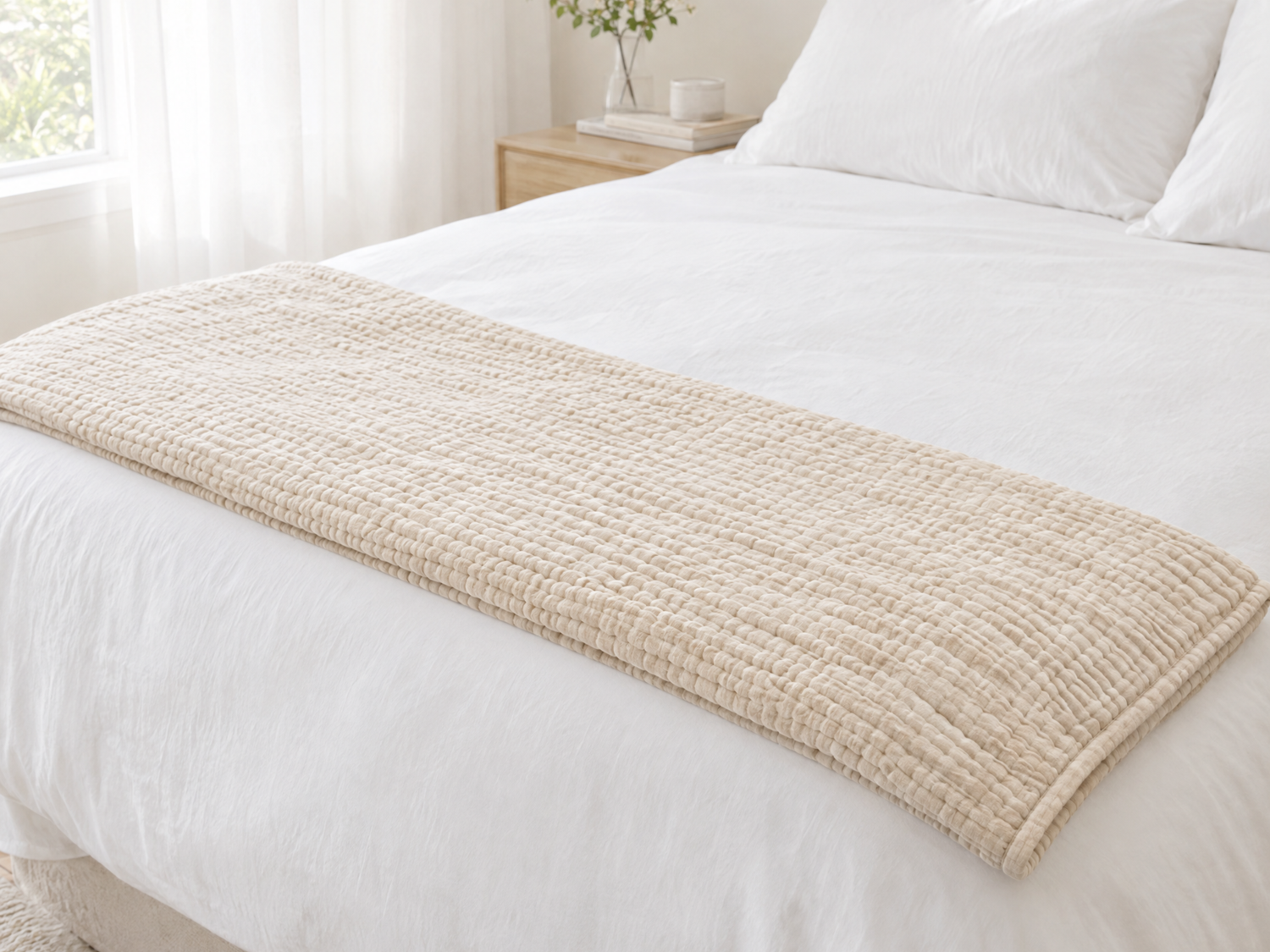
For most hot Australian nights, the right bedding is the lightest layer you'll actually keep on: a sheet on the worst nights, a cotton throw rug when you still want to feel covered, and a summer quilt only if your bedroom cools down overnight. An all-season doona usually belongs in the cupboard until autumn.
First, the words: quilt, doona and throw rug
Australian bedding has its own vocabulary, and it trips up anyone reading American or British buying guides.
- Doona and quilt mean the same thing here: a filled cover that goes inside a quilt cover. "Doona" began as a brand name and became the everyday Australian word for a duvet.
- Summer quilt and light doona are the lightest versions of that same thing, with less fill.
- Throw rug is a blanket with no fill at all: knitted, woven or gauze, thrown over the bed or the lounge.
- Sheet only is exactly what it sounds like: a flat top sheet and nothing else.
The difference that matters on a sticky night is the fill. Fill is what makes a quilt warm, and it's also the part you can't take away at 2 am. A throw rug and a sheet don't have any.
What GSM means on a quilt label
GSM stands for grams per square metre. On a quilt, it describes how much fill is packed into each square metre. Consumer group CHOICE points out that GSM tells you about weight, but not necessarily about warmth. It's only a fair comparison between quilts with the same type and grade of fill: a higher number in wool versus another wool quilt means heavier and warmer, but you can't line up a wool quilt's GSM against a polyester or down one and draw the same conclusion.
A few other things on the label help:
- Season words. Many quilts are sold as "cool", "warm" or "super warm". For summer, start at the light end of a brand's own range.
- TOG. Some quilts carry a TOG (thermal overall grade) rating. CHOICE puts 1 to 4 TOG as most suitable for summer, and 13.5 to 15 TOG for very cold conditions.
- The casing. The fabric shell that holds the fill is part of the quilt too, so check what it's made of.
One more thing: GSM on a throw rug or a sheet measures the fabric itself, not a fill, so it isn't comparable with a quilt's GSM. We haven't published a GSM for our own blanket yet, so we won't pretend to compare numbers here.
Summer quilt, light doona, throw rug or sheet: side by side
| Option | What it is | Fill | How it feels | Handy for | Watch out for |
|---|---|---|---|---|---|
| Sheet only | A flat top sheet, usually cotton or linen | None | Barely there | The stickiest nights and heatwaves | Some people don't feel settled with only a sheet |
| Cotton muslin throw rug | Layers of thin cotton gauze stitched into one blanket | None | Soft, crinkled, you feel covered | Warm nights when a sheet isn't quite enough; the lounge | Six layers is still a blanket, and too much for some people on the hottest nights |
| Other throw rugs | Knitted or woven blankets in cotton, wool or synthetics | None | Anything from airy to heavy | Layering, the lounge, cooler evenings | Thickness varies a lot, so read the material and look at the weave |
| Summer quilt / light doona | A doona with the lightest fill in its range | Light (wool, cotton, polyester, down and blends) | Light but puffy | Bedrooms that cool down after midnight; rooms with aircon | Still a filled layer; you can't make it lighter halfway through the night |
| All-season doona | A mid-weight doona | Medium | Noticeably warm | Autumn and spring, especially down south | Usually more than a humid summer night calls for |
If you're stuck between two options, go lighter and add a layer. Kicking off a throw rug is easy. Swapping a doona for a lighter one at 2 am is not.
Where a 6-layer cotton muslin throw fits
A muslin throw is made from thin layers of cotton gauze, an open weave that air can move through, stitched together into one crinkled blanket. There's no fill and no batting, so it sits between a sheet and a summer quilt: lighter than a quilt, more there than a sheet. If you're new to the fabric, our guide to whether muslin blankets suit hot sleepers covers the honest pros and cons.
Size matters with throws, because many are made for the lounge rather than the bed. Ours, the 6-layer cotton muslin throw, is six layers of 100% cotton gauze with no polyester in the fabric, and it measures about 115 × 185 cm (45″ × 73″) relaxed, which is how it lies on a bed after a wash and dry, and about 160 × 210 cm (63″ × 83″) stretched flat at the corners. Here's what that means on Australian beds:
- Single bed (92 × 188 cm): it covers the full width, with some to spare.
- Double (138 × 188 cm) or queen (153 × 203 cm): it covers one sleeper's side, shoulders to toes. It isn't made to cover the whole bed.
That personal size is deliberate. On a shared bed, a throw each means one person can have theirs on while the other kicks theirs off. The muslin blanket size guide explains relaxed versus stretched measurements in more detail.
Layering through an Aussie summer and into winter
Light layers you can add or remove give you more control than one heavy doona. Here's one way to run the year.
Summer (December to February)
Sheet on, throw rug folded at the foot of the bed. Pull it up when a cool change comes through or the aircon has been running for a while. On the hottest, most humid nights, the sheet may be all you want, and that's fine.
Autumn (March to May)
The throw rug goes on every night over the sheet. In the southern states, the summer quilt comes out towards the end of autumn, with the throw on top or folded at the foot.
Winter (June to August)
The doona comes back, and the throw moves underneath it as a middle layer. If you warm up overnight and push the doona aside, you're still under something.
Spring (September to November)
Run it in reverse: the doona goes first, the throw stays. In the tropical north, where nights stay warm most of the year, a sheet and a throw may be all you need for most of it.
Couples who run at different temperatures can split the bed instead of compromising. It's the idea behind the Scandinavian sleep method: a layer each, set up the way each person likes it.
If a muslin throw sounds right for your summer, every order is Buy 1, Get 1 Free, so two blankets arrive and you can mix the colours (Sky Blue, Sand and Blush): one for each side of the bed, or one for the lounge. Shipping to Australia is free and tracked. And if it isn't right, the 30-Night Comfort Guarantee means you can email us within 30 nights of delivery for a full refund, with no need to send it back.
FAQ
What GSM should a summer quilt be?
There's no single number. GSM measures the weight of fill per square metre, so it only compares fairly between quilts with the same fill. For summer, choose the lightest option within one fill type, or look for a 1 to 4 TOG rating if the label lists one.
Is a summer quilt the same as a light doona?
Yes. In Australia a quilt and a doona are the same filled bedding. "Summer quilt" and "light doona" both describe the lightest-fill end of the range.
Can I use a throw rug instead of a doona in summer?
Yes. A throw rug has no fill, so it's a lighter layer than a summer quilt. On the very hottest nights, a sheet on its own may be enough.
Will a 115 × 185 cm throw rug cover my bed?
On a single bed it covers the full width. On a double, queen or king it covers one sleeper's side, shoulders to toes, so on a shared bed it's one each.
Should the throw go over or under the doona in winter?
Under works well. If you get warm overnight and push the doona aside, the throw stays on, so you're not left with nothing.