
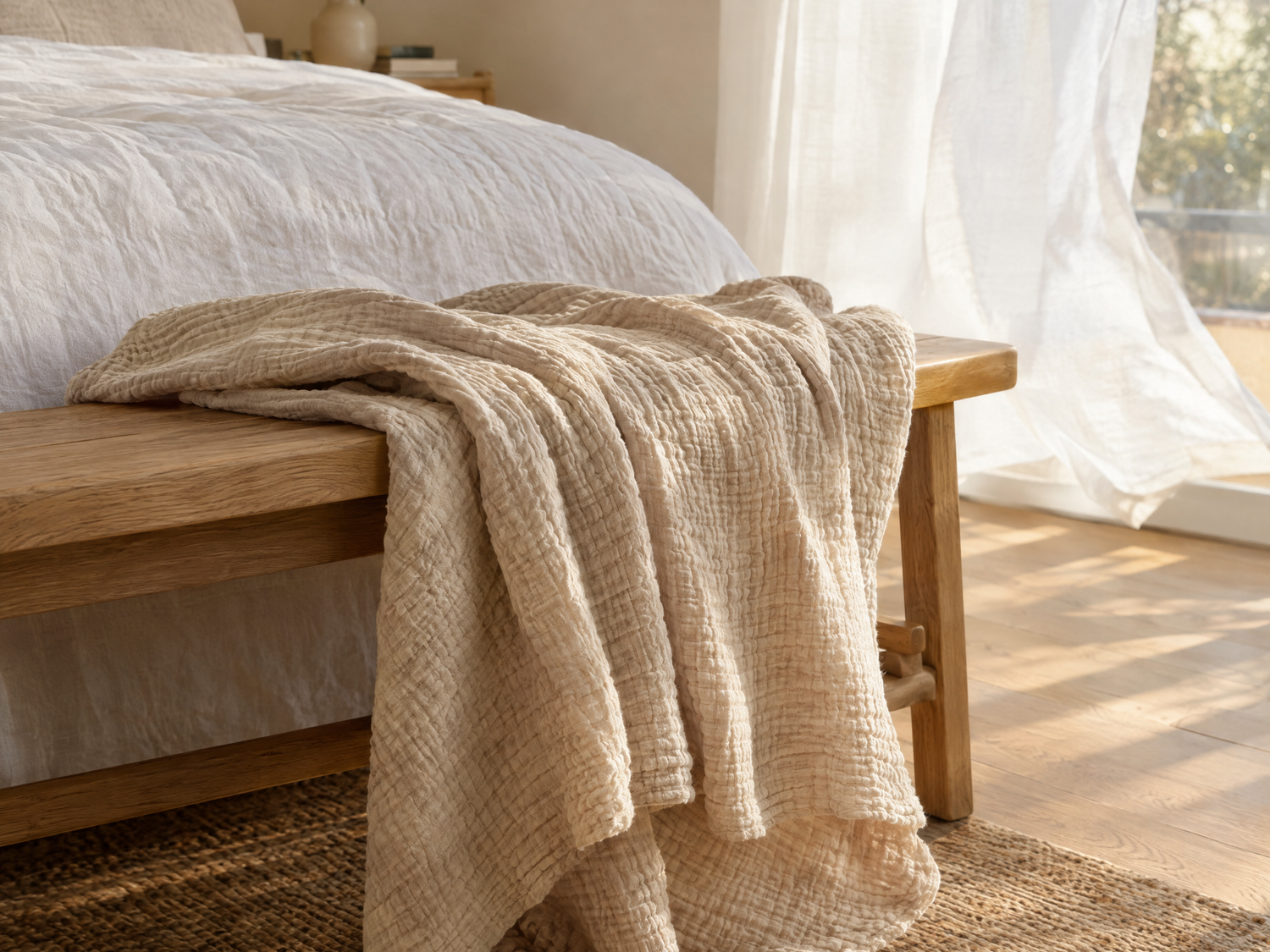
On its own, usually not. A muslin blanket is a light layer, and six layers of cotton gauze won't replace a comforter or duvet in a cold bedroom. In winter it works best in a stack: under your comforter, or over a sheet with a duvet folded at the foot, so you can adjust overnight.
Why a muslin blanket is a light layer
Most of the warmth in bedding comes from still air held in and between the fibers. A comforter or duvet is built around that idea: a shell stuffed with down, wool or polyester fill that traps a lot of air in one thick layer.
A muslin blanket has no fill. It's made from thin layers of cotton gauze stitched together, and its warmth comes from the small amount of air each layer holds. More layers hold more air, which is why a six-layer blanket has more body than a two- or four-layer one (our guide to 4 vs 6 vs 8 layers goes through the differences). But gauze is an open weave, and air also moves through it. That's what makes it feel light, and it's also why it isn't a winter blanket by itself.
So the honest answer depends on your room. If your bedroom stays warm all winter, or you run very hot, a muslin blanket on its own may be all you want. In a cooler room, you'll probably want more on top.
Why a light layer gives you more control
A comforter is one setting: on or off. Layers give you several. You can add or peel one off in a few seconds without getting up, and that matters in winter, because many bedrooms change temperature overnight.
The U.S. Department of Energy's Energy Saver guide notes that turning the thermostat down 7–10°F for eight hours a day in fall and winter can save as much as 10% a year on heating and cooling. In Canada, Statistics Canada reported that just over half of households with a thermostat (51%) lowered the temperature in winter while they slept, based on 2023 data. With a setback like that, your bedroom can be several degrees cooler at 3 am than when you went to bed.
A single heavy comforter can feel like too much at 11 pm and just right at 5 am. A light layer underneath lets you handle both ends of the night. It also helps when two people share a bed and don't agree on warmth: each person can set up their own side, which is the idea behind the Scandinavian sleep method.
Three ways to layer a muslin blanket in winter
1. Under a comforter or duvet
Fitted sheet, top sheet if you use one, then the muslin blanket, then the comforter or duvet. When you warm up, push the comforter down or off your side. The muslin stays put, so you're never left with nothing. It's the easiest setup to start with.
2. Over a sheet, with a duvet folded at the foot
Sleep under the muslin blanket and a sheet, with the comforter or duvet folded across the bottom third of the bed. If you get cold toward morning, it's one pull away. This suits people who climb into bed warm but cool off later in the night.
3. Two light layers instead of one heavy one
If even a light comforter feels like too much, stack the muslin with a second light blanket in cotton or wool. Two thin layers give you three settings: one, the other, or both.
A room-temperature guide for winter nights
Use this as a starting point, not a rule. People differ, and so do comforters.
| Bedroom at night | Typical situation | Try this | If it's not right |
|---|---|---|---|
| Warm: about 70°F (21°C) or above | Heating stays on, or a small, warm room | Muslin blanket over a sheet; comforter off the bed or folded at the foot | Still too warm? A sheet alone may be enough. |
| Mild: about 66–69°F (19–20°C) | Thermostat set back a little overnight | Sheet and muslin blanket, duvet folded at the foot | Pull the duvet up partway toward morning. |
| Cool: about 62–65°F (17–18°C) | A bigger setback, or an older, draftier house | Sheet, muslin blanket, then a light comforter or duvet | Kick the comforter off your side and keep the muslin. |
| Cold: below about 62°F (17°C) | Heat off, a cold snap, a cabin or basement room | Muslin blanket under a full-weight comforter or duvet; add a second blanket if needed | The muslin alone won't be enough here. |
Across the season, a common pattern in much of the US goes like this: in October and November, the muslin blanket alone covers most nights, with the comforter folded at the foot. From December through February, the muslin moves under the comforter. In March and April, it's back on top of the sheet. In much of Canada, comforter season starts earlier and runs later, so shift the dates to suit where you live.
Getting the setup right
- Check the size. Many muslin blankets are throw-sized. Ours measures about 45″ × 73″ (115 × 185 cm) relaxed, as it lies on a bed after a wash and dry, and about 63″ × 83″ (160 × 210 cm) stretched flat. It covers the full width of a twin, and one sleeper's side of a queen or king, shoulders to toes. On a shared bed, that means one each under a shared comforter.
- Leave it untucked on your side. A loose layer is easier to push off half-asleep than one tucked under the mattress.
- Keep it closest to you. In a stack, the muslin is the layer you keep, so it goes under the comforter or duvet, not on top.
- Plan on washing it more often than the comforter. Machine wash warm (max 104°F / 40°C) on gentle, then tumble dry low or line dry. Wash it on its own the first time; a little lint in the first wash or two is normal.
Where our blanket fits
We make one product: a 6-layer cotton muslin blanket, six layers of 100% cotton gauze in a crinkled weave, with no polyester in the fabric and no fill. It won't replace your comforter in January, and we won't claim it does. It's the layer that stays on when the comforter is too much, and the one you use on its own in the months on either side of winter. If you're wondering how it does in summer, see whether muslin blankets suit hot sleepers.
Every order is Buy 1, Get 1 Free, so there's one for each side of the bed, in any mix of Sky Blue, Sand and Blush. And if it isn't right, our 30-Night Comfort Guarantee means you can email us within 30 nights of delivery for a full refund, with no need to send it back.
FAQ
Are muslin blankets warm?
They add some warmth, from the still air held in and between the layers of gauze, and more layers add more. Compared with a filled comforter or duvet, though, a muslin blanket is a light layer.
Can I use a muslin blanket instead of a comforter in winter?
Only if your bedroom stays warm or you run very hot. In a cool or cold room, use it under a comforter or duvet, or over a sheet with a duvet folded at the foot of the bed.
Should the muslin blanket go over or under the comforter?
Under. That way it stays on when you push the comforter off, so you can adjust during the night without getting up.
Is a 6-layer muslin blanket warmer than a 4-layer one?
Generally, yes. More layers of the same gauze hold more air, so six layers feel more substantial than four. Both are still light compared with a comforter.
What if I run hot and my partner runs cold?
Layer each side differently. You might sleep under the muslin blanket alone while your partner adds a duvet or a second blanket on their side.